
When your dentist tells you that a tooth needs to be restored, one of the first questions you may have is, “Do I need a filling or a crown?” Both treatments can repair damaged teeth, but they are designed for different situations. Understanding the difference can make it easier to feel confident about your treatment plan.
At Eversmiles Dental in Pasadena, TX, we provide restorative dentistry designed to repair damaged or decayed teeth while helping you maintain comfortable, natural-looking function. Our restorative services include tooth-colored composite fillings and dental crowns, and we determine which option is appropriate based on the condition of your individual tooth.
A filling may be enough when the damage is relatively limited. However, when a tooth has lost significant structure or needs more protection, a crown may be the better choice. The decision is not simply about how much a tooth hurts. Instead, we look at the amount of healthy tooth structure remaining, the location of the damage, your bite, and the overall condition of the tooth.
What Is a Dental Filling?
A dental filling is used to repair a tooth after decay or relatively minor damage has removed part of its natural structure.
At Eversmiles Dental, we use composite fillings. Composite is a tooth-colored resin that can be matched to the appearance of your natural teeth. Because the material blends with the surrounding tooth, fillings can provide a discreet way to restore a damaged area.
One of the advantages of a filling is that it allows us to preserve more of the natural tooth structure when compared with restorations that require greater coverage.
When a cavity is discovered early enough, a filling may be all that is needed to remove the decay and restore the tooth.
What Is a Dental Crown?
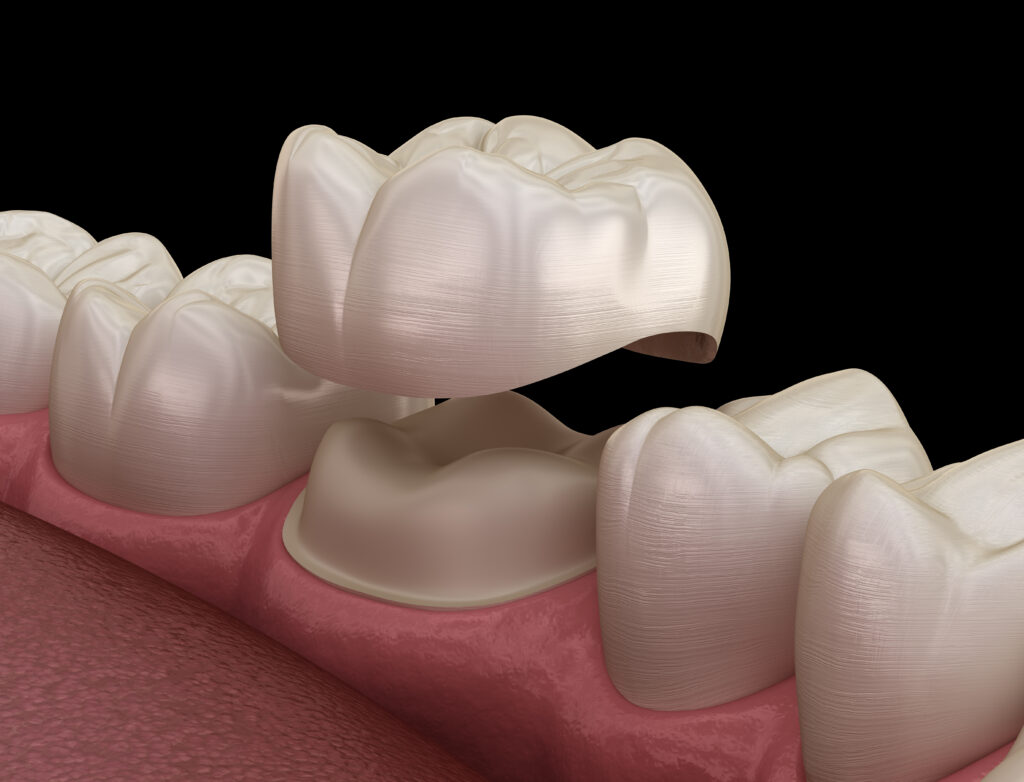
A dental crown is a restoration that covers the visible portion of a damaged or weakened tooth. Instead of repairing only a small area, a crown provides coverage around the remaining tooth structure.
Crowns can be used when a tooth has experienced significant damage or decay and needs additional protection. They may also be recommended after root canal therapy because the treated tooth may require additional structural support.
At Eversmiles Dental, crowns are custom-made to complement the shape, size, and appearance of your surrounding teeth. The goal is to restore both function and appearance while protecting the remaining natural tooth.
When Is a Filling Usually the Better Option?
A filling is often appropriate when the damaged portion of the tooth is relatively small or moderate and enough healthy tooth structure remains to support the restoration.
For example, imagine that a cavity has developed on the chewing surface of a molar. If the decay has not significantly weakened the tooth, we may be able to remove the damaged portion and restore the area with a composite filling.
Fillings can also be used to repair certain types of minor tooth damage.
Because composite fillings are bonded to the tooth, they can restore the affected area while maintaining much of the tooth’s original structure.
That preservation is important. Whenever a tooth can be predictably restored without unnecessary removal of healthy structure, a conservative restoration may be appropriate.
When Might a Crown Be Necessary?
A crown becomes more relevant when the tooth has lost enough structure that a filling may not provide adequate protection.
A large cavity can leave a tooth significantly weakened. Similarly, a tooth with a large existing filling may have less natural structure available to support another filling.
A crown may also be considered when a tooth has fractured or has been weakened by extensive damage.
Because a crown covers the tooth, it can provide a greater level of protection than a filling when the remaining tooth structure needs reinforcement.
However, not every cracked, broken, or damaged tooth automatically requires a crown. We need to evaluate the tooth first to determine whether it can be predictably restored and what type of restoration makes the most sense.
How Much Tooth Structure Matters
One of the most important factors we consider when choosing between a filling and a crown is how much healthy tooth remains.
Think of your natural tooth as a structure that needs enough support to withstand everyday chewing. If only a small section has been removed because of a cavity, replacing that section may be sufficient.
However, if a large portion of the tooth has been lost, simply filling the space may leave the remaining structure vulnerable to additional stress.
In those circumstances, a crown can provide coverage around the remaining tooth.
This is why two patients with what appear to be similar cavities may receive different treatment recommendations. The size and location of the damage, the strength of the remaining tooth, and the forces placed on that tooth all matter.
What Happens If You Keep Repairing the Same Tooth?
Some teeth have a long history of fillings and repairs. Each time a tooth is treated, the restoration and the remaining natural structure need to work together.
Eventually, a tooth may reach a point where another filling is no longer the most protective solution.
If a filling repeatedly breaks, the tooth continues to develop decay, or the remaining natural structure becomes significantly weakened, we may recommend considering a crown instead.
The purpose is to address the structural needs of the tooth rather than repeatedly treating the same area without considering the bigger picture.
What If Your Tooth Has a Large Cavity?
A large cavity does not automatically mean that the tooth needs to be extracted.
Depending on how far the decay has progressed and how much healthy structure remains, the tooth may still be restorable with a filling or crown.
If the decay has reached the inner pulp of the tooth, however, a filling alone may no longer be sufficient.
In that situation, root canal therapy may be recommended to treat the infected or damaged pulp and preserve the natural tooth when possible. Eversmiles Dental provides root canal therapy as part of our restorative dentistry services.
After root canal treatment, a crown may be recommended to provide additional protection for the restored tooth.
Can a Filling Fix a Cracked Tooth?
It depends on the type and extent of the crack.
Some forms of minor damage can be repaired with a filling. However, a significant fracture may require more extensive protection.
A crack can also extend into deeper areas of the tooth, potentially affecting the pulp. If that happens, the treatment plan may involve root canal therapy in addition to a restoration.
This is why it is important to have a cracked tooth evaluated rather than assuming that every crack can be repaired with a filling.
If you experience sharp pain when biting, sensitivity, a broken portion of a tooth, or persistent discomfort, contact us for an evaluation.
What If Your Tooth Does Not Hurt?
The absence of pain does not necessarily mean that a tooth is healthy.
Cavities can develop without causing noticeable symptoms, particularly in their early stages. A weakened tooth may also remain comfortable until additional damage occurs.
That is one reason regular dental examinations are important. We can identify areas of decay or structural damage before they necessarily become painful.
When a problem is discovered early, treatment may be more straightforward. A relatively small cavity may require only a filling, while delaying treatment can allow the damage to progress.
Does a Crown Look Like a Natural Tooth?
Modern dental crowns are designed with appearance in mind as well as function.
At Eversmiles Dental, crowns are customized to complement the surrounding teeth. Factors such as shape, size, and color are considered when creating the restoration.
The goal is to restore the tooth without making it look out of place within your smile.
Similarly, composite fillings are tooth-colored and designed to blend with natural tooth structure.
Both restorations can therefore provide a natural-looking result while addressing different levels of dental damage.
What Happens During a Filling Appointment?
If we determine that a filling is appropriate, we begin by making sure the affected area is comfortable and properly numbed.
We then remove the decayed or damaged portion of the tooth and prepare the area for the composite material.
The tooth-colored composite is placed and shaped to restore the missing structure. Once the restoration is completed, we check the bite to make sure the repaired tooth feels comfortable when you close your mouth and chew.
Our goal is to restore the tooth while preserving as much healthy natural structure as possible.
What Happens During Crown Treatment?
Crown treatment involves more extensive preparation because the restoration is designed to cover the tooth.
We first evaluate the tooth to determine whether it is a good candidate for a crown. If so, the tooth is prepared so the crown can fit securely.
The crown is designed to restore the tooth’s shape, size, appearance, and function.
The specific process and timeline can vary depending on the condition of your tooth and the type of restoration being used. We explain the steps involved in your individual treatment plan before moving forward.
Can a Crown Be Used After a Root Canal?
Yes. Crowns are commonly used as part of the restoration of teeth that have undergone root canal therapy.
Root canal treatment removes infected or damaged pulp from inside the tooth and seals the interior. However, the tooth may already have experienced significant structural damage from decay, a crack, or previous dental work.
A crown can provide coverage and protection for the remaining tooth structure after root canal treatment.
At Eversmiles Dental, root canal therapy and crowns are both part of our restorative dentistry services.
Why You Should Not Choose a Restoration Based on Symptoms Alone
Two teeth can cause similar symptoms but require completely different treatments.
For example, sensitivity could result from a cavity, a damaged restoration, a crack, or another dental issue. Likewise, a tooth that does not hurt may still have significant decay.
That is why we do not determine whether you need a filling or crown based solely on how the tooth feels.
An examination allows us to look at the condition of the tooth and determine how much healthy structure remains.
How Can You Help Your Restoration Last?
Whether your tooth has a filling or a crown, your daily oral care matters.
- Brush your teeth twice each day.
- Clean between your teeth every day.
- Attend regular dental examinations.
- Avoid chewing ice or other extremely hard objects.
- Do not use your teeth to open packages or containers.
- Contact us if you notice sensitivity, pain, a rough edge, or a change in your bite.
- Follow any specific care instructions provided after your restoration.
Taking care of the surrounding teeth and gums is also important. A restoration does not replace the need for good oral hygiene.
What If You Are Not Sure Which Restoration You Need?
You do not have to determine that on your own.
If you have been told that you have a cavity, broken tooth, worn restoration, or another form of dental damage, we can evaluate the tooth and explain your options.
Our goal is to choose an appropriate treatment based on the actual condition of the tooth. Sometimes that means a composite filling is enough. In other cases, a crown may provide the additional protection the tooth needs.
When a tooth requires more extensive treatment, we can also explain how restorative procedures such as root canal therapy fit into the overall plan.
Protect Your Natural Teeth With the Right Restoration
Choosing between a dental crown and a filling is not simply a matter of choosing the more extensive treatment. It is about matching the restoration to the condition of the tooth.
A filling can be an excellent choice for cavities and minor damage when enough healthy tooth structure remains. A crown can provide additional coverage and protection when a tooth has become significantly weakened or damaged.
At Eversmiles Dental, we evaluate each tooth individually and explain why a particular restoration is being recommended. Our goal is to help you preserve your natural teeth, restore comfortable function, and maintain a healthy-looking smile.
Find Out Which Restoration Is Right for Your Smile
If you have a cavity, damaged tooth, old filling, or tooth that has become sensitive, do not wait until the problem becomes more difficult to treat. Eversmiles Dental provides personalized restorative dentistry in Pasadena, TX, including composite fillings and dental crowns.
Call Eversmiles Dental at 281-741-9180 to schedule an appointment and find out whether a filling or crown is the right restoration for your tooth.